
Caregiver Documentation
One approach we plan on bringing to this project is documentation. Documentation is a core tenet of the Reggio pedagogy, allowing educators and parents to see themselves as researchers, capturing images and documenting observations of children’s learning in order to understand the child’s point of view and cognitive processes. One of the questions we are curious about is how can we invite caregivers into the documentation process? And before we even get to that question, can we find out their thoughts and attitudes about documentation to judge their understanding and interest? What will be meaningful, what will be accessible?
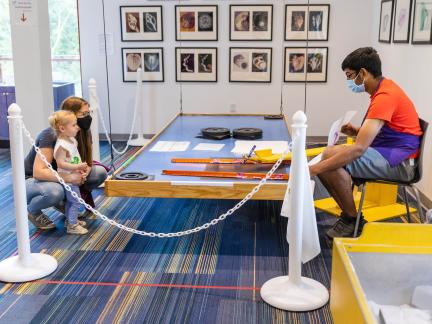
To start simply, we tried giving several caregivers a clipboard with several reflective questions to respond to. Staff observed and photographed their observations and surveyed visitors afterwards about their experience. Here is a sample from a participating family:
How are your children exploring the room?
They are trying out what they can do with the different things in the room. T is racing the different columns of washers down the rods. R took out all of the puzzle pieces and put them back in.
What is catching their attention?
Things that make noise, things that don’t do what they expect. He noticed that the washers make different sounds.
How do you know they are interested?
They are staying and playing with things for a longer period of time. They started to fight over things (that they both wanted to play with).
As simple as these questions and responses were, I did find that they changed the caregiver’s experience during that portion of their visit. In the follow-up survey this specific caregiver reported that she found herself paying closer attention to her child while using the documentation sheet. Observing these interactions I wondered about how we can simultaneously encourage two very unique behaviors in caregivers: to participate in their child’s experience through questions and observations, and to act as an observer carefully watching and noticing ideas and abilities. I wondered if these 2 roles were in conflict with each other as this particular caregiver would step back to observe and document, only to have to step in to play the role of the disciplinarian because her absence and allowed disagreements to occur. However, as she stepped back to observe she also asked questions to the children about their experiences, it is hard to know if these are questions she would have asked anyway or if they were prompted by the questions she was reflecting on.
Additionally interesting is that the few families that participated in this impromptu and un-coached documentation session agreed with the statement that they “think of The Discovery Museums as a place where you can learn more about your own child.” Although it is unclear how exactly we will utilize documentation in this new exhibit space, it appears that caregivers generally do have some level of interest in documentation and that they believe this is space where they can learn more about their children.
There are many museums trying to find out how they can implement documentation in their spaces. In school classroom spaces you have the advantage of following a child or topic over a long period of time and go in depth where desired. In museum spaces we generally don’t know who is walking through our door, if we have ever met them before, and what their engagement level will be – all of which create challenges to creating rich documentation in museum spaces. I have been excited to continue this conversation with several other museum educators as facilitated by the Democracy Inquiry Group (DIG) and hosted at the Documentation Studio at Wheelock College. As we continue to have this conversation at a field wide level I’m reminded of the strength of our Partner Advisory Council, two of our advisors having incredibly strong backgrounds in Reggio as represented by The Documentation Studio at Wheelock College and Opal School of the Portland Children’s Museum.
Questions to the Community
Have you had success in getting visitors to share their photos and videos from their visit?
When does a photo become documentation?

Comments
Add new comment